Description

This blog contains book reviews, comments on interesting things and a smattering of self promotion. Enjoy.


Showing posts with label History. Show all posts

Friday, 19 February 2016

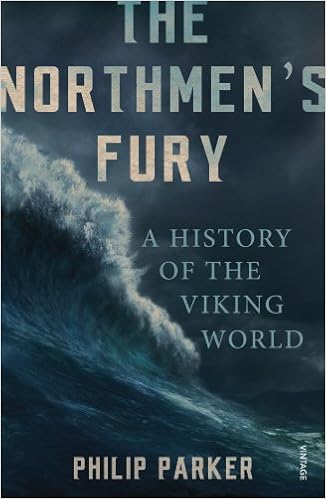
Book Review: The Northmen's Fury - A History of the Viking World by Philip Parker

This year I’m using the power of the twenty-sided die to force myself to read more widely. My first role showed a 12 for ‘History, Myth and Legend’, and so I headed into Waterstone's with my Christmas gift card and had a rummage. With everything that has ever happened (and a significant quantity of things that didn’t) to choose from, it was a difficult decision. In the end I let my current obsessions choose for me, and selected Philip Parker’s history of the Viking world ‘The Northmen’s Fury’.

For a while, when I was in primary school, Terry Deary’s Horrible Histories took up the most space on my bookshelf. Those books first introduced me to the joys of reading and of history, but while I still find the past fascinating, I’m a little ashamed to admit that until I embarked on this project, I had never read a history book aimed at adults. For somebody who has not fostered the skill of reading history, The Northmen’s Fury is perhaps a difficult place to start. This is no fault of Parker’s – he writes clearly and engagingly, but he does so about a contradictory people, and across a field which is both temporally and geographically huge.

One thing that history has in common with the novel is that both concern themselves with cause and effect, but when the primary sources are as sparse and biased as they are for the Vikings, motivations can be hard to follow. While the Vikings had a writing system in the form of runes, they left little record of themselves other than a few monumental inscriptions often following a simple ‘X raised this rock in memory of Y,’ formula. One or two of these appear to corroborate information from the much later sagas, but they do little to help Parker tell the ‘story’ of Norse culture. This largely non-literary, largely pagan culture spent a significant amount of time attacking Christian neighbours who did keep fairly detailed historical records. Add to this the fact that many of their victims were monks – the very people writing those records – and it is little surprise that contemporary sources created the, barbaric picture of the Vikings that remains in many people’s minds to this day. They were, of course, sometimes capable of brutal violence, but no more so than many of their neighbours. Parker tells us of the massacre of the Danes who had settled in England, as ordered by King Aethelred, during which even the children of ‘those women who had consented to intermix with the Danes’ were ‘dashed to pieces against posts and stones’.

When the Vikings’ descendants did develop their own rich literary heritage in the form of the Icelandic sagas, Parker is careful to remind us that they were written down many years after the events described (presumably as the culmination of an oral tradition), and that many of them serve to legitimise the claims of this or that Norwegian royal house. While he acknowledges the potential unreliability of his sources, Parker does not shy away from presenting much information from them as fact – a decision which can be justified by imagining the difficulty and tedium involved in reading a book which presents every single action as something that may or may not have happened.
The difficulty in following the chain of causality is not always helped by the fact that the Vikings tended to travel widely, and Parker’s decision to divide up many of his chapters geographically (although some areas get different chapters for different periods), means that we sometimes have the same historical figure appear in different chapters without necessarily following their careers in chronological order. It should be noted however that Parkers systematic approach is useful in giving a sense of organisation to this history’s vast scope. Those readers who would like an approach which more closely examines the biographies of the period’s key players will find themselves well served by the book’s penultimate chapter: a set piece centred on the dual invasions of England in 1066 which follows lives of each of the three key players up to that point. Parker is seemingly helped here by the more detailed sources available for this period, and manages to shed new light on a period I thought I knew well. The life of Harald Hardrada is particularly interesting: he spent a number of years fighting in the Byzantine empire’s Varangian guard before taking his throne in Norway, and seemed to be the most experienced of the three generals vying for the crown of England.

I do not wish to suggest that Parker himself is responsible for the sometimes confusing nature of the book. He does a very good job of providing readers with a structured history of a people whose motivations are lost to time, and who sometimes do things which seem bizarre to the modern reader. For example, several of the kings of Viking Dublin seem to have abandoned their thrones to take up kingship of York, or vice versa, and at least one later changed his mind, returning to Dublin to oust the relative who had ruled in his place. Adding to the confusion is the fact that it sometimes seems as though almost all of the era’s major figures are called Harald or Olaf, and thus they almost all bear the patronym Olafson or Haraldson.

When I studied A-level Archaeology, the parts I found most interesting were the small glimpses we occasionally get into the lives of people from long ago. It is in these moments that this book is also at its best. For example, the small group of Norse Christians returning from the crusades who took shelter in the Neolithic tomb at Maeshowe on the Orkney islands, and occupied their time in carving coded runes into the walls with messages varying from boasts about the skill of the carver, to praise for Ingigerd, ‘the most beautiful of women’, and even a claim that a large pile of treasure that was removed from the tomb and buried somewhere nearby (probably an example of Viking humour – as Parker points out, the sparse, primitive grave goods we find in stone-age tombs are unlikely to have been of much interest to Norse warriors). While the style here is still very much that of a fiction book, we as readers are in the tomb with the band of crusaders while the storm rages outside.

As might be expected from a history of the Vikings (and probably of any early medieval group) the story we are told predominantly concerns the military elite, with the lives of the everyday folk fading into the background. This is understandable, as the farmers who likely made up the majority of the population had little opportunity to do much that would be worthy of record in sagas or in monks’ records. We do get more of an idea of the lives of ordinary people when Parker turns his gaze across the Atlantic to focus on the settlements of Iceland and Greenland, and the probable forays into parts of North America (interestingly, the Greenland colony, which almost certainly collected resources from the American mainland, made its last written records in 1408, and archaeological evidence suggests that the colony may have survived until the latter half of that century – only decades before Columbus’s discovery of America). In these chapters we are presented with a people who resisted any form of leadership which is too autocratic – both Iceland and the Isle of Mann have claims to the oldest running parliaments in the world – but whose isolation and infighting eventually caused them to submit to Scandinavian monarchies which would later neglect them in times of need.

As well as valuing independence, the Viking people are presented as being great technological innovators whose long-boats allowed them to strike deep inland along river courses, and whose navigational skills allowed them to build up a trading network which stretched as far as Constantinople and the Middle East. Their cultural sphere of influence stretched from Kiev and Novgorod in the east, to the shores of America in the west, but their lack of one unifying government – and their sometimes Game-of-Thrones-esque political infighting – prevents them from being considered as an empire on the scale of the Romans or the Macedonians.  

In the final chapters, Parker deals with the descendants of a small group of Vikings who settled in the  France, and went on to found dynasties across western Europe. He also discusses the 19th Century cultural interest in the Viking myth and acknowledges how parts of it were appropriated by the Third Reich (although he does not mention the ongoing rift between Neo-nazi and non-racist factions in contemporary Germanic Neopaganism), a system of government which would almost certainly have appalled those Vikings who braved the unforgiving North Atlantic in order to avoid what they saw as increasing tyranny in Scandinavia and set up communities which we would now recognise as being run along democratic lines. In this respect it’s also worth noting that the Viking societies seemed happy to trade and intermarry with people of many different cultures and religions, and in areas like Normandy and Russia they eventually became fully integrated with the surrounding people.

This is connected to one of the core things I was reminded of by this book. History is always more complex than we imagine it. In popular culture, Vikings are very much the pagan outsiders ransacking Christian Europe, and while there is an element of truth in this, it is worth remembering that they were also shrewd traders, whose politics were deeply interwoven with their neighbours, particularly in the British Isles. I was also surprised to learn that, while it took a long time for Christianity to become established in the Nordic countries (and Norway had a pagan rebellion as late as the 12th Century), there is evidence that there were Christians in Scandinavia at the very start of the Viking period, and Christians were involved in the settlements of both Iceland and Greenland. This should not be a shock, given the Viking age starts five centuries after the Roman Empire had made Christianity a dominant faction in Europe. One thing about the pop-culture Viking which does seem to be true is their preoccupation with being remembered in stories, and I’m sure the many Haralds and Olafs mentioned here would be pleased to see their names recorded a millennia after they passed into the afterlives of their chosing.

Next time I read a history books, I might opt for something with a narrower focus, but I very much enjoyed this overview of a period I have long been interested in. My next roll of the dice was an eleven, for a genre novel. I opted for The Watchers by Neil Spring. Watch this space for a review.

Sunday, 19 July 2015

Book Review: 'The Wake' by Paul Kingsnorth

Hastings, 1066. For many of us this is where English history begins. Before this, we are taught, a few barbarian warlords wrestled the land away from the equally barbaric Celts in the power-vacuum left by the Romans, then squabbled over it for the next 500 years or so until William the Conqueror and his knights chased away the dark ages, restoring civilization, establishing Chivalry, and setting England on her path to the glorious empire of the 19th Century.

The cliché tells us that history is written by the winners, and this particular propaganda has been persistent. It is pretty much the story I learned in primary school, and seems to have echoes in the ‘Our Island Story’ curriculum Gove was pushing a couple of years ago. This book, though, is concerned with the losers. For Buccmaster of Holland, 1066 marks the death blow for England, but it is not a clean wound. The Wake follows Buccmaster into the forests of Lincolnshire, where he becomes a ‘green man’, fighting a guerrilla war against the French invaders.

One of the challenges of historical fiction, even if it deals with primarily fictional characters, is how to engage readers in a story with a foregone conclusion. Kingsnorth approaches this by focussing on Buccmaster’s personal journey against the backdrop of a hostile foreign occupation. When telling a tale like this, there is a temptation to write about a heroic underdog, leading his noble but ultimately tragic people in a final stand against tyranny, but here the big historical players, William, Harold, and even Hereward the Wake, whose epithet gives the novel its name, exist only as distant rumours[i]. The Norman invaders are inarguably oppressive, but the inequalities in English society are accepted as natural by the characters, and Buccmaster does not see the irony in his adoration of the Anglo-saxon raiders who had crushed the existing Romano-British culture in the same way he fears the Normans will destroy the English way of life.

Buccmaster himself is decidedly unheroic. He is petty, arrogant, probably delusional and ultimately pathetic, but it is through his voice that the story is told. While he is sometimes a difficult character to like, it seems right that we should see these events from the point of view of somebody who is ordinary and flawed; most of us will only ever play bit-parts in the grand narrative of human history, and in Buccmaster, Kingsnorth gives us protagonist who struggles to see this, both as an individual, and as a representative of a culture in terminal decline.

One of the novel’s great successes is the way that it brings Buccmaster’s voice and his world vividly to life. This is achieved through Kingsnorth’s great experiment: in recognition of the fact that ‘our assumptions, our politics, our worldview, our attitudes’ are reflected in the language we speak, the novel is written in a ‘ghost tongue’ – an approximation of Old English designed to be accessible to modern readers. What could easily have become a gimmick is in fact one of the strongest aspects of the novel, and while the language takes a little perseverance at first (and perhaps more so if you aren’t already involved in word-geekery), it soon becomes natural. Other than a few of the more unusual words (most of which are covered by a glossary), I found that within a few pages, I was able to read and comprehend the language as it is, rather than needing to mentally translate. In fact, Kingsnorth’s ‘ghost tongue’ lives up to its name, as I found its vocabulary sticking with me after I had put the book down. In attempting to write in a language which has not been moulded by a thousand years of loan-words, and political, economic and philosophical change, Kingsnorth gives his narrator a speech which is rooted in agriculture, the natural world, and a pre-feudal view on human society, avoiding the trap of giving his 11th Century characters 21st Century minds. This ghost-tongue also has a lyrical beauty of its own: ‘it is early in the mergen mist is risan from the waters and on top of the waters is mos grene lic the grenest daeg and deop below deop in the blaec water can be seen great leafs what is suncan almost from sight. all is flat all this land is flat naht stands abuf the reods. low we is and we gan slow through the green and naht is to be seen but the water…’

This 11th Century mind-set does not mean that the novel has no relevance today. Kingsnorth has written non-fiction about the loss of English cultural identity, and it is interesting to read the novel in a society where this is increasingly dominated by nationalists. The book offers no answers, but it did make me wonder if the paranoia about immigrants eroding the English way of life might stem from deep cultural memories. Whether you start English history at 1066 or in the 5th Century with the first Germanic settlers, the national origin story is one of conquest and displacement. I do not wish to draw comparisons between the Norman conquest and the migration patterns of the last century – a top-down, military subjugation of the native population is clearly entirely different from a steady influx of families and individuals looking for greater economic or social stability – but I suspect these deep-seated invasion narratives from our early history have coloured some aspects of the debate on migration.

For the English of The Wake, there can be no period of gradual adjustment. When William the Bastard seizes the thrown, it marks a catastrophic end to the Anglo-Saxon way of life. The language may be unfamiliar, the protagonist unsympathetic at times, but this book offers an intimate exploration of the way people might react to such a complete destruction of their way of life while offering some insight to an often overlooked period of English history from the perspective of those who are not destined to be remembered.


[i] It is interesting, as a modern reader, to experience a society where news cannot travel faster than a man can walk. The world seems bigger – more isolated. Important events are one step removed from the characters’ lives.

Wednesday, 17 April 2013

NaPoWriMo 16

This one may be a day late, but since the aim is to produce 30 poems in 30 days, I still have time to catch up. For those of you wondering why only a few poems have made it onto here, it's because I'm selfishly hoarding the rest, revealing only short samples on Facebook and Twitter.

Here's today's effort:

Damnito Memoriae

 They put their chisels to her name,
and in a chattering of bronze
on bronze, she turned to crumbs of stone.

The Nile yawned and stretched, spine-like,
as the nation woke from a dream
remembered in uneasy frescoes,

as a sentence with the nouns torn out.

Tuesday, 18 January 2011

Book Review: Stephen Fry, 'Making History'

Before I begin, I'd like to point out that I've talked before about celebrity novelists. More specifically, I've talked about Jordan, and how stamping her name on a few ghost written rags does not give her the right to call herself a writer. I know that I shouldn't judge books I've never read, but I'd still rather break that rule than discover great works of literature are floating around Waterstones with Jordan's name on them. Besides, she still hasn't chosen to defend herself by accepting my challenge to a short story competition.

Stephen Fry is a completely different case. Firstly, because he has a discernible talent other than finding new ways to whore himself to the tabloids, and secondly (and more importantly) because as far as I am aware, he does write his own books. This leaves just one more thing to note before we embark on the review proper, and that is that way back in 1996, Fry predicted the iPad, right down to the use of little symbols to represent the different apps.

Now onto the review.

If you were given the power to alter history, what would you do? Would you try to stop Hitler? This is one of the most obvious answers to that question, and it forms the central premise of the novel. The book is divided into two parts, the first of which begins with a chance encounter between Micheal 'Puppy' Young, a PhD history student at Cambridge, and physicist, Professor Leo Zuckerman, inventor of a machine which allows the user to see a moment in history, and to send simple objects back in time. The two develop a plot to stop Hitler from having ever been born, and then put this plan into action. In this half of the book, chapters following Young and Zuckerman are alternated with flashbacks detailing the relationship between Hitler's mother and her abusive husband in the early years of Hitler's life, and then showing us episodes from Hitler's time fighting in the First World War. Fry manages to make real, human characters out of both obscure historical figures and of the most hated figure of the twentieth century.

In the book's second half, Micheal finds himself on a drunken night out in Princeton with almost complete memory loss. Over the next few chapters we see him piece together the details of his life in this new version of history, while details of what brought him there return to his memory. Fry again alternates Michael's first person narrative with chapters set in the First World War, although this time in Hitler's absence we watch as one Rudolph Gloder is promoted through the ranks.

Meanwhile, back in Princeton, Michael discovers the world he has created is far from perfect. He might have eliminated Hitler, but he did not eliminate the oppressive conditions Germany was subjected to in the aftermath of the Great War, nor did he eliminate the nationalistic and antisemitic sentiments which they produced. In the world where Michael finds himself, Gloder, a far more efficient and charismatic leader than Hitler, became Fuhrer and subjugated Europe. America has been in a long cold war with Nazi Europe, creating oppressive government of its own. The civil rights movement, and those other movements it spawned, never happened.

Fry knows his form well, and is not afraid to experiment with it's conventions. While most of the chapters set in the present (both as we know it and in the alternate world) are in standard first person narrative, there are a few chapters which Fry presents as film scripts. At first this can come across as confusing, and disconnects the reader from the protagonist somewhat. On the other hand, it allows him to skip through large portions of time in a montage form, while literally sticking to the 'show, don't tell' motto popularised in many creative writing classes. It also serves to emphasis the difference between film heroes and heroes in novels, namely, that characters in films are by necessity men (or women) of action, whereas characters in books are given the opportunity to contemplate their actions.

One criticism of this novel would be Fry's decision to make his protagonist gay halfway through the books second part. In itself this would not be an issue, but there are not enough hints before hand to make the transition seem believable, and those we are given seem forced. This could have been solved by either making Michael gay from the very beginning (if this was the sexuality Fry wanted to give his protagonist), or by giving more hints from the beginning of the book that this might happen. Other than this, Fry's characterization is extremely good, and very believable. Granted, if he were less sinister, Gloder would come across as something of a pantomime villain, being one half Red Dwarf's Ace Rimmer ('What a guy!') and one half Shakespeare's Iago, but he is an enjoyable character to read.

I would recommend Making History to anyone interested in history, whether that be real or alternate. It is a fine reminder that history is often more complex than we think.

Friday, 12 March 2010

The Joys of Wikipedia

I'm sure that anyone who is in anyway involved in the university system is used to being told how wikipedia is at it's best too simple and at it's worse too apocryphal to be used as a source of academic information. This is probably true, but I feel that it somehow misses the point. Wikipedia is not there to replace academic journals, it is there as a repository of interesting (or sometimes not so interesting) information for the general reader. This function, it fulfills magnificently. And if it is occasionally inaccurate it is worth remembering that for every ill-informed mistake or malignant lie that is posted there are hundreds of informative articles, and a horde of researches wait to swoop down like eagles to correct the inconsistencies.

Wikipedia is also very good for finding interesting things which you weren't even looking for. For example, a few weeks ago I was looking at the Wikipedia entry on Samuel Taylor Coleridge as research for my Life Writing assignment. My tutor, the much-praised Mr Ian Marchant, actually encourages this sort of behaviour, taking the view that for a creative module, it is far more important to be interesting than to be accurate (as long as we are still aiming for some sort of truth). This not only led to my discovery of the man from Porlock which became the focus of my project (Coleridge's excuse for Kublah Khan being 'unfinished' was that he was interrupted halfway through by a visitor from Porlock which, in short, made him lose his mojo), it also led me to a less relevant but arguably more interesting discovery. I got distracted. forgetting for a moment that both Xanadu and 'The sacred river Alph' are both entirely fictional, or at least mythical, I decided to look up the real Kublai Khan and see if he had tried to build 'a stately pleasure dome'. He hadn't. A map on this page caught my attention though, and below that map was a name. That name was Rabban Bar Sauma.

It turns out that there had been a christian tradition in China and Mongolia as far back as the 7th century. This in itself was unexpected and fascinating, but then I discovered that Christianity was also a strong force in ancient Mongolia which it seems was much more cosmopolitan than might be expected. Rabban Bar Sauma was a christian monk, born somewhere near modern Beijing, which was then part of the Mongolian empire. Sometime in what wikipedia vaguely calls his 'middle age', he decided to make a pilgrimage to Jerusalem with his student, Raban Marcos. Because of Military unrest in the middle east (some things never change) they never made it to Jerusalem, but ended up in Baghdad, where they met the Patriarch of the Eastern Orthodox church. They carried out some diplomatic work for the Patriarch, failed to return home because of more military unrest, and when the Patriarch died, Marcos was elected as his replacement.

The story did not end here (although judging by the length of this post it might have been better for my readership if it had). Marcos then appointed Bar Sauma to make a diplomatic journey westwards. By this point he was in his late sixties. On this journey he met the Byzantine emperor, witnessed an eruption of Mount Etna, failed to meet the pope (who had died not long before he arrived in Rome) but negotiated with his cardinals, met several European kings, including Edward I of England, returned to Rome and met the new pope, (who allowed him to celebrate his own Eastern Eucharist on Palm Sunday in the Vatican). He then returned to Baghdad bearing gifts for his former student from the new Pope as a sign of inter-church good will, and spent the remainder of his life there writing down his adventures.

I know it's unfashionable to stick a moral on a story, but I feel a post this long needs something to justify it. Something along the lines of 'you're never too old to start an adventure' seems appropriate. It also makes me wonder how big the gulf was between far eastern Christianity (which would have been effected by contact with Buddhism and other oriental philosophies) and the western forms of Christianity we are used to. Maybe Wikipedia can tell me.