Description

This blog contains book reviews, comments on interesting things and a smattering of self promotion. Enjoy.


Showing posts with label Book Review. Show all posts

Thursday, 9 August 2018

A review of Kate Fox's 'Watching the English' and some additional thoughts on Englishness


Maybe it’s the world cup, maybe it’s Brexit, but I’ve been thinking a lot about Englishness recently. Specifically, I’ve been thinking about how those of us on the political left might reclaim Englishness from the right. At this point you might be wondering what good a sense of national identity is to a liberal, internationalist remoaner. In ignoring the problem of Englishness for so long, we have excluded those for whom a sense of Englishness is important while also allowing the right to entirely control the narrative of what Englishness means. And while an excess of patriotic pride can lead to a whole host of problems, there is nothing inherently wrong with feeling a sense of belonging to a place, a people or a history, so long as we do not start to believe that this makes us better than those who do not share these things. I picked up Kate Fox’s Watching the English partly because there were no relevant George Orwell books in the library at work, but it turned out to be a great place to begin my investigation. Fox is a social anthropologist, and in this book she sets out to uncover the hidden rules which define English culture. This analytical attempt to define Englishness as it is, rather than as any nostalgic or political viewpoint would like it to be, is a necessary starting point in imagining what a progressive, forward looking Englishness could become.

Fox is an entertaining guide, pitching her writing towards what she claims ‘used to be called the educated layman’. Her writing is peppered with personal anecdotes, amusing observations and an undercurrent of the sort of humour which she sees as our ‘default mode’. There is a touch of Douglas Adams’ biscuit story to her account of pushing into queues or bumping into strangers for research purposes. Balancing her light-hearted prose, Fox structures the book like a serious academic investigation, defining key anthropological ideas in her introduction before systematically applying the ‘participant-observer’ methodology to different aspects of English society and identifying patterns and themes along the way.

As might be expected of the co-director of the Social Issues Research Centre, this investigation, however lightly written, is underpinned by thorough research, and the depth of Fox’s knowledge is evident throughout, although she rarely includes statistics (which would seem dry and out-of-place in a work of pop-anthropology). However, while Fox makes occasional references to ‘cross-cultural studies’, and is keen to point out that some of the traits she identifies are not uniquely English, I did feel in places that the book lacked enough specific references to other cultures to truly clarify what makes English culture different. A dog is not just defined by the fact that is a four-legged domestic animal, but also by the ways in which it differs from a cat or a horse, and in the same way it would have been nice to have some examples of how English attitudes differ from the attitudes of the Germans, the Vietnamese or our neighbours the Scots, the Welsh, the Irish. We are told in the introduction that, although a certain amount of overlap is to be expected, Fox is interested in Englishness rather than Britishness, but she never follows this up by suggesting how these cultures differ.

I particularly wonder about the pervasiveness of Fox’s core features of Englishness – what she calls our ‘social dis-ease’ – in other parts of our islands. For Fox, this social dis-ease is central to English identity, and she sees it as the key to two seemingly irreconcilable sides to our culture: our reputation for polite reserve and our notoriety as violent, drunken yobs. While I don’t see myself in the latter stereotype, I definitely felt a pang of recognition in many of the more ‘awkward’ behaviours – the potential for embarrassment, the negative politeness, the desire not to make a scene, the awkwardness of greetings and farewells. Turns out I’m not socially-awkward, just English. I do wonder whether this feeling might be more universal than Fox suggests though, in the same way that everyone on the internet self-identified as introverts a few years ago. Perhaps everyone has this sense of ‘social dis-ease’ and some cultures and individuals are just better at hiding it than others.

As you might expect from a book on English culture, social class features heavily. Fox chooses to include sections on class in every chapter, rather than devote a chapter to class in its own right, as she theorises that class norms and an awareness of social class pervades all aspects of our society. Fox is clear that she is making descriptive, analytical judgements on the distinctions between classes rather than prescriptive value judgements, but in parts of the book where she is not addressing social class directly some of her assumptions seem to be unconsciously based on middle class attitudes and norms. She also identifies the usage of ‘dinner’ or ‘tea’ to describe the evening meal as a class indicator, while I had always understand it to be a north/south geographic divide (and my tendency to switch between them as a midlands quirk). I was willing to defer to her expert opinion on the matter (and reassess my uncertainty as a symptom of my mixed class-background), but a recent YouGov survey seems to support my initial instinct. Perhaps English class consciousness is so deeply rooted that even when she is attempting to play the part of the detached observer, Fox cannot quite escape her own biases. I must also confess to these biases: while reading, I found myself unable to avoid measuring her descriptors against my own behaviour and being secretly pleased that I am more likely to say ‘sorry’ than ‘pardon’ if I mishear somebody, unwittingly providing evidence for Fox’s portrayal of the lower, less established middle class[1] unease with their status – their tendency to want to look ‘higher’ than they are. According to Fox, this tendency is more-or-less absent from the working classes and the upper-middle to upper classes, and most prominent among the lower-middles and (to a lesser extent) the middle-middles, who are both keen to distance themselves definitively from the class below. When introducing us to the idea that hidden ideological systems govern our thoughts, one of the lecturers on my degree course emphasised that, once we step outside of these ideologies and recognise them as constructs, we can never truly step back in. Apparently English class consciousness is so strong that attempting to dissect it only serves to make it stronger.

Focussing on a universal grammar of English culture, Fox does not really address English politics, and while it was interesting to see her lay out a grammar of Englishness, the book has little to say on how Englishness can be reclaimed from the nationalists. In fact, English nationalism is not mentioned at all and while Fox is happy to address a number of anti-social behaviours, the only reference to racism is in the context of how, in the ‘orderly disorder’ of Fresher’s Week or New Year’s Eve, ‘telling bawdy jokes is fine, but racist ones are inappropriate.’ It is tempting to imagine that overt racism and nationalism have become more prevalent since the book was published in 2004, but where I grew up not only were openly racist jokes fairly common, but so were far-right political candidates and pro-Combat 18 graffiti. Perhaps a playful examination of a culture is not the right place to examine truly serious socio-political issues. Neither does Fox really address the plague of nostalgia. While she identifies that, from washing machines to restaurants to politicians, we generally don’t expect things to be very good or work particularly well, she does not comment on the related fact that many of us believe things were better in the past. Depending on your political bent, that past might be the height of British Imperialism, or it might be the post-war Labour Government with its radical social policies. It might be the Thatcher years or the cultural explosion of the Beatles and the Stones. For many of us, perhaps perversely, Britain’s golden age comes in WW2, with all of us coming together through food shortages and bombs to show the Nazis what for. One thing is certain, the country is going to the dogs. The politics/music/people of tomorrow are bound to be worse than those of the past. I used to think this was a universal trait, rather than a particularly English one, but recent research shows that our island neighbours do not share this view. In Scotland, Wales and Northern Ireland, more people believed that their country’s best years were ahead of them.

One useful concept Fox does have, however comes right at the beginning of the book when she is defining her terms. Englishness, as described here is a cultural category rather than an ethnic one. To some extent this argument seems facile – ethnicity itself is a culturally constructed concept rather than one that has a real basis in science. But the way we talk about culture and the way we talk about ethnicity differs significantly. Culture is system of behaviours and attitudes – something we acquire, while ethnicity is bestowed upon us by accident of birth or perception. By thinking of Englishness not as an ethnic categorisation but as a set of cultural norms one can acquire or adopt, we can neutralise nativist attempts to define English identity as one that can only come from some sort of imagined pure bloodline, but this view risks encouraging those arbiters of Englishness to judge immigrants (and by extension, those who have been here for their whole lives, but who ‘look foreign’) by the degree to which the adhere to a particular pattern of English behaviour. This is all part of the knotty problem that humans naturally look for a sense of group identity, but that all group identities (national, sub-cultural, religious, sports team-related) are, by their very nature, exclusionary and divisive.

I have a few things to add here, but none of them really go very far in solving this problem. Firstly, in any culture, no individual will perfectly embody all of the attitudes, values and behaviours associated with it. Whether your ancestors arrived with Hengest and Horsa, on the Windrush, or last Thursday on a flight from Krakow, there will be elements of English culture that you display, and elements you that you do not. Throughout her book, Fox refers to the underlying rules of English as a ‘grammar’, and I think this is a useful comparison. Linguists describe the rules of a language as it is used by its speakers, they do not prescribe how it should be used – if the language changes, the linguists will record this change and look for causes, but they will not tell the people who are using the new rules that they are ‘doing it wrong’. This brings me rather nicely to my second point. All cultures change over time. As people come from different places, bringing their own cultures with them, it will inevitably have an impact on the culture that is already there. But becoming the sort of country that tightly controls our borders, that tries to police a prescribed view of Englishness, would also have an impact, and, I believe, would tend to exaggerate some of our less desirable qualities. Finally, we should not confuse culture with citizenship, and we should not confuse citizenship with a right to reside in a country. As new people arrive, they will naturally adapt to their new cultural environment (and remember, it is perfectly possible to belong to more than one culture), just as their new environment will be changed in some way by their presence. A progressive version of Englishness would welcome these people into our land and into our culture as part of a new chapter in what it means to be English.


[1] Although my own class background is probably more complicated than that – I could write a whole blog post trying to work it out. For now I’ll just say that I’m describing myself as ‘lower-middle’, not because I think that is better than being ‘working’ but because, despite having always lived in working-class areas, to describe myself as ‘working-class’ would be to claim a cultural identity that I don’t really have.

Sunday, 9 October 2016

Book Review: 'The Raw Shark Texts' by Steven Hall

Rifling through the bookshelves at my grandmother’s house a few years ago, I discovered that my grandfather used to make pencil notes in the fronts of the books that he read. His intentions, I suppose, were a little like my reasons for writing book reviews on this blog – a way of processing his thoughts on what he had read, what he could learn from it. In one of them (possibly something by Samuel Butler), I found the phrase ‘too much philosophy, not enough plot’. Now, I like my books with a dose of philosophy, but I also understand the need for an engaging story, so when I heard about The Raw Shark Texts, it seemed to be just the sort of thing I was looking for. This book shares DNA with works by Umberto Eco or Scarlett Thomas (and it was no surprise to see that latter named in the acknowledgements page), blending the conventions of a tight thriller with big philosophical ideas. We meet our protagonist, Eric Sanderson, with no memory of his past or his identity – the victim of a Ludovican thought shark, one of many species of conceptual fish which have evolved to swim in the ebb and flow of human ideas. With no memory of his previous life, Eric is already in critical condition, and it seems that the shark will return to eat away at his consciousness until there is nothing left.

Thus starts a journey into ‘unspace’, the nameless service roads, carparks and passageways which form the cracks in the modern world, to find the one person who might be able to help. Along the way, Eric is joined by ‘Scout’, a young woman using unspace to hide from a shadowy and terrifying being known as Mycroft Ward. I do not want to spoil Ward’s secret, but he is one of the most original and unsettling antagonists I’ve read about recently. Scout’s explanation of Ward’s backstory is one of the novel’s finest moments, and it is just a shame that he stays too remote to feel like a real threat for most of the book.

In some ways, this is very much a novel about how it feels to be hunted, with Scout and Eric both running from forces which will not stop. The idea of ‘unspace’ is also an attractive one – a sort of alternate world which is both mysterious and mundane, and easily believable to anyone who has ever explored and abandoned building, or looked into the organic, messy ways that cities grow.
Scout is a well written character – plucky and adventurous, but forced to live in a self-imposed exile which cuts her off from the real world. She also acts as a useful guide, helping us to understand the world that Hall presents us with.  Though his portrayal of the relationship between Scout and Eric, Hall demonstrates and understanding that even if a fast paced thriller, tension comes from the dynamic between characters as well as from external threats. However, Hall also creates a connection between Scout and Sanderson’s dead fiancée which is never satisfactorily explained. Novelists are entitled to maintain a sense of mystery, but this one opens up possibilities which do not feel entirely consistent with the rest of the story.

Mention of Clio Aames, Eric’s fiancée, brings me to another element of the novel. Alongside the tense thriller, we are given a picture of grief over the loss of a partner and a relationship which seem almost too perfect. This is made somehow more poignant by the fact that the protagonist has no memory of anything which happened before the start of the novel, and can only find out about one of the defining parts of his life the same way we do – by reading a fragment of a story written by his previous self. His most significant relationship is essentially something which happened to somebody else.

The novel is particularly interested in identity and memory. Eric draws a clear distinction between himself and ‘the first Eric Sanderson’. Our memories of others can affect their identities too. We like to think our dead loved ones live on somehow in our memory, but  Hall makes clear that this is just a version of that person – an image seen from only one direction and distorting as we get further away: Hall calls attention to this idea in making the relationship between Eric and Clio seem so perfect. I wonder if the same principle applies to living people too; our ideas of them may not match up with their ideas of themselves, and our true identities probably lie somewhere between our own self-images and the images that others have of us.

The question of identity is taken in a chilling new direction by the Mycroft Ward subplot, which spoilers prevent me from detailing here.  That’s the great thing about fiction – you can take and idea and stretch it to breaking point while retaining the emotional impact which the abstractions of philosophy sometimes lose. In the end though, the novelist must come to some sort of resolution. After spending the majority of the novel feeling like an imitation of the first Eric Sanderson, our protagonist is able to become the real thing, combining his new experiences and adventures with those aspects of the original that he has been able to glean from the record his predecessor left behind. While the ending wraps up some of the philosophical questions a little too neatly, Hall is able to draw the thriller plot to a satisfying conclusion.


The Raw Shark Texts is not a perfect novel. It experiments with extracts of ‘found’ texts and with the shapes of the text on the page in ways which never feel fully realised, and in times of intense action the author adopts a rather breathless, fragmented style of writing. Words flying off the paper. The reader struggling to maintain footing. An author overusing the present participle. Perhaps it is just the grammar nerd in me which objects to this, but I found that while the lack of a proper main-verb to anchor the sentences helped to create a sense of pace, it also jarred me out of the world of the novel and back on to the train, where Eric Sanderson and the Ludovican existed only as names on a page. Despite these criticisms, this is an ambitious and entertaining read which largely succeeds in balancing philosophy and plot. There is also a cat called Ian, and as I would recommend the book for that reason alone, we are both lucky that Hall does such a good job.

Wednesday, 7 September 2016

Book Review: 'Trilogy' by H D

Back when I used to skateboard (an unusual way to start a discussion of Modernist poetry, I know, but bear with me) watching promo videos of professionals doing interesting things always made we want to get out there and have a go for myself. This is how I felt when I first read Trilogy. During my final year at university, one of my assignments was to put together a collection of poetry, and I threw myself into the task. Inspired by Seamus Heaney’s North, Geoffrey Hill’s Mercian Hymns and Ted Hughes’ Crow, I tried to combine elements from myth, religion and history to say something about our own time. Then, a little over a year after I finished my degree I found a woman who had done the same thing, so much more elegantly and subtly than I managed, for hers.

The three books which make up Trilogy[1] were written in London during the height of the Second World War. The war itself seeps in and out of the poem – sometimes it seems very far from the events and ideas being described, others it bubbles to the surface. It is most evident towards the beginning of The Walls Do Not Fall, the first book, and I wonder whether the poem began life as a civilian war poem before expanding into something bigger. In the poem’s opening section, the speaker walks through once familiar parts of London, her ‘old town square’, and sees where railings have been taken ‘for guns’. Amid the ‘mist and mist-grey’ of the bombed-out city, she sees echoes of Egypt where, like the wrecked houses of London, the temples and tombs are doorless and ‘open to the sky’. In the wreckage of everyday life, ‘poor utensils show / like rare objects in a museum.’ These connections seem to predict the city’s destruction, but the ‘frame held’ and some essence of the city endures, leaving the speaker with a sort of survivor’s guild which leaves her contemplating why she has been able to survive, and what purpose art can serve against such destruction.

Actually, H D never really seems to doubt that poets can justify their existence, and parts of The Walls Do Not Fall grows out of a defence of art against the suggestion it is ‘pathetic’ for poets to try to express world issues or that there is no need for activities which are not obviously or practically useful (incidentally, Norman Pearson’s introduction to my Carcanet edition is invaluable in providing background information). After referring to books being reduced to ash, and ‘old parchment’ being used ‘for cartridge cases’, H D responds to a direct challenge (‘what good are your scribblings?’) with a reminder that ‘we take them with us beyond death’. The question of the usefulness of art is as relevant as ever today, in a world which seems at least as complicated than that of World War Two, even if the threat is not as clear or as imminent: How should the artist respond to acts of terror, to the rise of demagogues, or to such levels of global uncertainty? For H D, the answer seems to go beyond simply bearing witness, it is a core part of human existence, going right back to ‘in the beginning was the word’. We do not get a straightforward defence of poetry’s usefulness – rather, we are given a demonstration of how it can weave a web of complex ideas, connecting vastly different times and circumstances to hint at (but not necessarily reveal) some underlying truth. In this collection, poetry becomes a form of secular magic.

I am an atheist (albeit, a non-militant one) with very little patience for new-agey, mysticism-as-self-help woo, so it is worth considering why this poem, unashamedly Christian and seeped in Kabbalistic ideas, makes me want to go back and read it again almost as soon as I reach the final lines. I think in part it is because, while H D was a believer, and I am not, we both share a similar view of how religion, myth and mysticism work best – as great archetypical symbols which allow us to express and explore ideas about what it is to be human. Perhaps unsurprisingly for a time of such upheaval, Christian ideas about death and rebirth recur throughout this poem, and seem to be reflected in its three-act structure, but H D also draws from ancient Greek and Egyptian mythological traditions, seeing rhymes and connections between paganism and Christianity, which perhaps reach their zenith in the claim that ‘Amen [king of the Egyptian gods] is our Christos’. For me, this syncretic fusion of concepts is what poetry is all about.

Despite the potential complexity of H D’s ideas, her language is clear, and the pictures she paints are as crisp and vivid as we might expect from one of the founders of the Imagist movement. This is most prominent in each book’s main set piece. In The Walls Do Not Fall, the speaker is visited by a figure described as ‘Ra, Osiris, Amen’, hinting heavily that this figure is also the Christian God, while presenting us with an image which contrasts sharply with the pop-culture image of what God looks like. He is ‘beardless, not at all like Jehovah’, and choses to appear in the ‘eighteenth-century / simplicity and grace’ of a ‘spacious, bare meeting house’. This setting may be a reference to H D’s non-conformist Protestant upbringing, but its controlled neatness also provides a contrast with the chaotic destruction outside. This figure’s appearance seems to answer the question set up in the poem’s opening section: ‘we wonder / what saved us?’ In A Tribute to the Angels, the speaker is visited by a female figure who seems to be connected with the Virgin Mary, but also with several pagan goddesses. This figure carries a book which we are told ‘is not / the tome of ancient wisdom, // the pages… are the blank pages / of the unwritten volume of the new’, perhaps vindicating the role of the artist in a world which has been altered by global war.

In the poem’s final volume, The Flowering of the Rod, the set-piece comes not in the form of a visitation, but as an imagined meeting between Mary Magdalene and Kasper (of three-wise-men fame), in which she acquires the alabaster jar of myrrh with which she will anoint Jesus’ body. This extended meeting, which takes up the majority of the third volume, allows H D to create her own myth, perhaps as a further attempt to demonstrate the role of art, while also forging a link between Jesus’ birth and his death (the jar of myrrh is said to be one of ‘two jars’ which were ‘always together’, the other being the jar which was given to Jesus at the nativity), which resonates with the Christian idea of Christ’s sacrificial purpose and further explores the theme of rebirth and transformation. While this section is the most overtly Christian part of the poem, it is not as simple as it might first appear. H D includes rumours about Kasper’s identity, where ‘some say he was Abraham / some say he was god’, while Mary Magdalene is linked in one character’s mind to ‘a heathen picture // or a carved stone-portal entrance / to a forbidden sea-temple’. Even in the parts of the book which seem most intimately connected with a Christian message, H D seems determined to make connections between Christian and non-Christian mythologies, with Kasper, who ‘technically… was a heathen’ naming the seven devils which had been cast out of Mary Magdalene as ‘Isis, Astarte, Cyprus… Ge-meter, De-meter, earth-mother / or Venus’, goddesses who had been praised earlier in the poem, and even linked with the same archetype as the Virgin Mary.

There is more to Trilogy than mysticism and close description though. Throughout the work, H D’s narrative voice shifts in its relationship with the reader, and in its level of certainty. At times, the poems’ ‘you’ seems intimate, perhaps even directly addressing the friends to whom the different volumes are dedicated, at others, ‘you’ is positioned as an antagonist – a foil against whom the speaker can expound and demonstrate her arguments. The poem seems to admit the difficulties in achieving accurate expression: the visitation of the female figure in Tribute is riveted with tentative interjections of ‘what I mean is –‘ and parenthetical asides, culminating in a dialogue between the speaker and the imagined reader, in which H D attempts to address any inaccuracies in the impression she has created. In doing this, she explores the imprecision of literary art – with a few words we try to create an approximation of what we are trying to describe, but it is really up to the reader to complete the picture, and the image they receive is not necessarily the same as that which the writer broadcasts. If this is true of something as relatively straightforward as visual description, it must be doubly true of more complex ideas, and this complexity is referred to throughout the poems, with images of poetry as ‘an indecipherable palimpsest scribbled over // with too many contradictory emotions’, or ‘a jar… a little too porous to contain the out-flowing / of water-about-to-be-changed-to-wine’. It is this richness, this ability potential to carry multiple interpretations and to create meanings beyond the sum of its parts which gives poetry its value in an uncertain world.

However, despite its celebration of poetry’s complexity, despite the breadth and sometimes the obscurity of its references, Trilogy is not a hard-slog of a book. Using clear language and a simple form (the poem is made up almost entirely of blank verse divided into two-line stanzas) H D creates a multi-faceted work, which argues strongly for the power of art against a backdrop of war and myth. There are few poets who create such a perfect balance between clarity of language and ambition of scope.


[1] I think it is probably most accurate to think of Trilogy as one epic-length poem in three parts, rather than as three related collections of poetry, so throughout this discussion I will refer to the whole piece as ‘the poem’.

Monday, 1 August 2016

Book Review: 'Neither Here Nor There' by Bill Bryson

The next category in my continuing quest to read more widely was ‘travel/memoir’. Under these circumstances, my former tutor, Ian Marchant sprang to mind. Unfortunately, Waterstone’s didn’t have any of his books in stock, and I was reluctant to lose momentum waiting for a delivery (however, if you like beer, and you’re looking for a book which is well informed, erudite and funny, you could do worse than look up The Longest Crawl).

So, with this plan thwarted, and with and impatient fiancée in tow, I settled for probably the biggest contemporary name in the genre. In spite of the old cliché, I’d be lying if I said I wasn’t influenced by the cover – a vintage travel poster style drawing of the Hagia Sophia, its domes and minarets dwarfing the houses huddled below, while two silhouetted figures look on across a busy straight of sunset orange water.

Neither Here Nor There meanders across Europe. We join Bryson en route to Hammerfest, a small city in the far north of Norway with a name which sounds like it should be a metal festival (and, as it turns out, is), and follow him across fourteen countries (more if you count using modern borders) ending in Istanbul. Bryson is an engaging guide – irreverent, but still able to find glory in his surroundings. He somehow balances a wide-eyed everyman persona with a casual understanding of art, architecture and history, transitioning seamlessly between laughing at smutty paintings in the Louvre, and being awestruck by the grandeur of Charlemagne’s cathedral in Aachen.

One reason that this approach seems to work is that Bryson constantly positions himself as an outsider. He is as lost in these unfamiliar cities as we are, and his ignorance of European languages is not from a bullish tourist arrogance, but because of an almost Romantic addiction to this outsider status. Bryson revels in happy accidents and unexpected turns of events. This is reflected in his somewhat shambolic approach to his journey, which sees him zigzagging in and out of Germany, and deciding on a whim to skip over half the continent to get from Stockholm to Rome. He is also honest about the mundanities of travel, and we spend almost as much time looking at industrial complexes from the windows of slow, over crowded trains and perusing the lacklustre menus in mediocre restaurants as we do in historic buildings or overlooking sublime alpine landscapes. For Bryson, this is all part of the adventure, and his slapdash attitude to travel is contagious. Within a few chapters, I found myself looking up cheap flights to Bruges in my break at work (unfortunately they weren’t quite cheap enough).

Of course, a solo trip around Europe does have the potential disadvantage that most of the narrative tension comes from finding hotel rooms or train tickets. Bryson remedies this by including anecdotes from a much earlier European adventure with an old school friend, Stephen Katz. Katz acts as a foil to the young Bryson’s enthusiasm, unimpressed by his cultural experiences and more sensitive to the discomforts of travel. The two young men do share a late-pubescent preoccupation with sex and drinking, but by the end of the trip they are barely speaking. The extent to which this tension is exaggerated for literary purposes is unclear, but it seems that the friendship was not unsalvageable, as Katz turns up again in a latter Bryson book, A Walk in the Woods.

Part of me would have liked more exploration of the potentially interesting tension in retracing a gap-year style journey as a mature adult, but despite his willingness to share amusing and potentially embarrassing anecdotes, Bryson chooses to keep the primary focus of the book on the joys and trials of travel itself. That is not to say that it is without more serious moments. For example, Bryson’s depiction of Bulgaria at the end of the communist regime, hit by hyper-inflation, and with an almost complete lack of consumer items stifling its nascent capitalist economy. The book often treats the poorer areas of cities as being equally interesting and worthy of our attention as the historic and economic centres, but it is here where Bryson explores the problems with this position and the glamour of being an outsider is replaced with guilt at his privileged position. He can retreat from the bleakness of the town into a hotel which bars local people from even entering. He is desperate to spend some money in the city, but can find nothing to buy.

While Bryson displays his liberal-leaning social conscience here, his depiction of women sometimes seems a little old fashioned. This is less problematic it the sections with Katz, where it perhaps reflects the attitudes of two adolescent men in the 1970s, but becomes a awkward when we find the fourty year old Bryson’s leering at ‘the sort of bottom that made your palms sweat’ attached to a woman in the tourist information office in Amsterdam. I do not think that Bryson in a misogynist, but this perhaps illustrates how society has changed since the book was written in the early 90s. Bryson’s attitude towards the Germans is also indicative of his age and the time the book was written. Like Basil Fawlty before him, he seems unable to look at Germans without being reminded of the war. Given recent events, I was curious to find out what Bryson’s attitude to what was then the EEC and was a little surprised to find that our Europe-loving guide was a Eurosceptic, albeit primarily due to a fear of homogenisation which clashes with his Romantic sensibilities.


Compared to my last two choices, this was an easy book to read – I flew through it in about a week – but Bryson delivers more than melt-to-nothing candyfloss. With humour and lightness of touch, Neither Here Nor There touches on issues of globalisation, and international politics, but overall, it stands as a love letter to Europe, and to the variety of human culture, and to the urge to explore. 

Monday, 25 July 2016

Book Review: 'One Hundred Years of Solitude' by Gabriel García Márquez

One Hundred Years of Solitude reads like a history which takes place in a dream. The novel follows five generations of the Buendía family, from the patriarch, José Arcadio’s founding of the city of Macondo, to its destruction many years later. This was my first experience of the ‘magical realism’ genre, and I had been expecting something along the lines of Kafka’s Metamorphosis, although perhaps without the emphasis on horror. In some ways, this comparison is accurate – the ‘magic’ that occurs in the novel is not a force in the world of the story which is governed by an internal logic, as we might find in a fantasy novel, it is somewhere between fairy-tale and surrealism: at times the story’s supernatural elements come as ghosts or as prophetic utterances, at others, they seem more like metaphors which actually take place, like when one family member, who lives in another part of town, dies, and has a line of blood trickle from their nose and across the town, finding its way to the family home. Unlike Kafka though, Márquez does not present us with any close psychological investigation – we are one step removed from the characters, and while we are sometimes told what they think, we do not generally experience events through them.

Another possible point of reference for reading this novel was Wuthering Heights – both are cross-generational tales about families with far fewer names than people (the Buedía’s include four José Arcadios, five Aurelianos, an Aureliano José, an Arcadio and several combinations of Úrsula, Amaranta and Remedios, not to mention seventeen illegitimate Aurielianos), but while Wuthering Heights is very much about how one generation can affect the next, the Buendías seem to move across the years on the impulses of an inescapable fate, rather than motivated directly by the actions of their forebears. Some traits, however, do recur across the generations – fanatical drives towards unattainable goals and a compulsion to unmake and remake the same things over and over again.
While the title gives us a very precise ‘one hundred years’, time keeping within then novel is much less precise. While events fall in roughly chronological order, we might follow one character along one thread of their narrative, only to be told down the line that ‘this was about the time…’ that something key in another character’s plotline occurred a few pages earlier. Some events seem to act as anchor points, referred too long after (or sometimes long before) they actually happen, as memories or pieces of narrative prolepsis; the novel opens with the sentence ‘many years later, as he faced the firing squad, Colonel Aureliano Buendía was to remember that distant afternoon when his father took him to discover ice’ – both events which become anchor points later on. This can be a little confusing, but the large cast of similarly-named characters is much more of a hindrance in this regard than the temporal vagueness. The anchor points, and the use of recurring motifs help to prevent the novel from feeling unfocused, but it does sometimes seem to lack a clear narrative drive; while there are peaks and troughs, there is no familiar overarching pattern of rising action, climax, falling action. What we get instead is a sense of the epic, even when the novel’s concerns are primarily domestic. We follow entire generations of this family from birth to the grave against the backdrop of a city’s journey from obscurity to prosperity to abandonment, and all the while, history marches forwards with its relentless drive towards modernity.

While they often seem isolated from the rest of the world, the citizens of Macondo are not wholly unaffected by history. Its drawn out, brutal civil wars between barely distinguishable liberals and conservatives, its occupation by an American banana company and subsequent labour troubles, rhyme with the history of several nations in the region. At times, the novel seems to move very quickly through these broad sweeps of history, but some of the most effective writing comes when Márquez slows almost to a standstill.

The multi-generational approach means that this novel covers a much broader sweep of human life than many other works of fiction. Not only do we see childhood, adolescence, adulthood and old age represented for us, we see it represented repeatedly across many important characters. Cycles of growth and decline provide much of the structure for One Hundred Years of Solitude, but after a while it is the sense of decline and decay which sticks in the mind. The old frequently outnumber the young in the Buendía household, with a number of characters living far beyond their expected years. Sometimes, like Úrsula or Santa Sofía, work quietly away in the background, holding the household together; some hold on to ancient grudges and regrets, some fall into obsessive routines, some decline into madness. Even those who have died occasionally reappear. The house itself, one of the first built in Macondo, probably ranks alongside the House of Usher and Satis House as one of the great symbolic homes in literature. When the family and the town prosper, new rooms are added, when the family sees a change in matriarch, new furniture is brought in, and when the old begin to outnumber the young, cracks appear until eventually entire wings of the house are abandoned to the ants.


The novel often feels meandering and unreal, but that often seems to be the point. The characters are engaging, if not always fully rounded, and the last couple of pages bring the rest of the book into some sort of focus. I suspect this won’t be my last foray into magical realism.

Sunday, 29 May 2016

Book Review: 'Waverley' by Walter Scott

I chose Waverley after rolling an eighteen – ‘a book I never finished’ – in my D20 reading challenge, and it is perhaps telling that there has been such a significant gap between this post and my last.

I first attempted Waverley during my second year at university, as part of a module on the Romantics, and it was this novel which caused me to break my vow to finish reading all of the required course material. This book begins a generation before the protagonist has even been born, then proceeds to explain his childhood and education in great depth, and in a style which even Scott himself admits is ‘what scholars call the periphrastic and ambagitory, and the vulgar the circumbendibus’. This sustained barrage of exposition was too much for me; I surrendered, and opted to simply write my assignments about a different text.

Returning to it six years later, the long trudge through the first volume still failed to enthral me, and it is not until the twenty-fourth chapter that the main thrust of the narrative begins. After this point, I quite enjoyed the novel, but there was part of me which begrudged the amount of time it took to get to there.  Part of my impatience with the earlier half of the novel stems from a sort of conscientious discomfort around the way that the aristocratic protagonist seems to see no problem with taking off on a months-long jolly around Scotland within weeks of beginning his military career.

Sense of entitlement aside, Edward Waverley makes a fairly likeable hero, in the Romantic bildungsroman tradition. He has a strong sense of honour, but is naïve, and has allowed Romantic novels and tales of chivalrous derring-do to shape his understanding of how the world works. Despite this, the character sometimes seems a little flat – particularly in comparison to others in the novel who are much more memorable. In particular, Scott draws warm, believable comic characters in much the same way that Dickens would a few decades later.

One useful aspect of Waverley’s ‘flatness’ is that he becomes a sort of blank space for the reader to project themselves upon, and it is through his English eyes that we are first introduced to exotic world of Jacobite-era Scotland. This journey takes place in stages, from the comfortable, pastoral England of his uncle’s estate, to the military encampment in Edinburgh, then on to the almost feudal Barony of Bradwardine, and ultimately into a highlands inhabited by outlaws and by tribal chiefs. This gradual march into the unknown has some sense of thematic importance, but unfortunately lacks a real sense of purpose until its final stage.

As a modern reader, it is tempting to see Waverley as a story of radicalisation, and the charismatic Fergus Mac-Ivor could be interpreted as a manipulator, guiding the inexperienced Edward Waverley into rebellion. However, we should be careful in drawing parallels with the radicalisation of young men into extremist causes in today’s society. Scott is ambiguous in his portrayal of the Jacobite rebellions, and while he is sure to show that his protagonist is, to some extent, tricked into pledging himself to the highlanders’ cause, he is also careful to include honourable and dishonourable characters on both sides.

Although some of Scott’s best writing comes in his description of the Battle of Prestonpans, his depiction of Waverley’s rebellion is strangely toothless. Despite volunteering with the Jacobites, Waverley seems to spend the majority of his time on the battlefield trying to prevent government soldiers from being killed. This is understandable, as contemporary readers may have found it difficult to sympathise with a hero who commits fully fledged acts of treachery, but it does soften the impact of the protagonist’s eventual disavowal of the Jacobite cause. Similarly, while Scott does offer some brief comments on the effects of war on the landscape, his most emotionally charged description is saved for Tully-Veolan, the great house of the Baron of Bradwardine. Scott is pre-occupied with ideas about inheritance and property, and on some level the novel can be seen as tracing Waverley’s growth into a suitable lord, complete with a suitable wife.

It is not just the rebellion which is toothless: the government’s response seems unbelievably lenient. While Mac-Ivor and his foster brother are put on trial and executed for their crimes (another of Scott’s finest scenes), Waverley and the Baron of Bradwardine receive convenient pardons with very little trouble, and the last chapter seems particularly contrived.

Despite its flaws though, I found Waverley to be an interesting read. While the first-volume is dry and overly-long, Scott does make good use of seemingly incidental details later in the novel. Scott’s self-aware authorial interjections seem to pre-empt Forster’s ‘One may as well start with the letters’ – one of my all-time favourite opening sentences – and serve as a reminder that novels have been experimenting with narrative voice since the very beginning. There are things about the novel’s structure which work very well, and it can be enjoyed as an early example of a historical novel, or as a straightforward adventure story, even if it fails to fully address the moral complexities of civil war.

Saturday, 19 March 2016

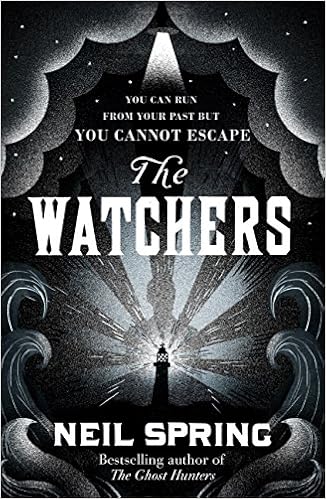
Book Review: 'The Watchers' by Neil Spring

Warning – while I have tried to avoid major plot details, it is impossible to discuss my thoughts on this book properly without some spoilers.

Cold war paranoia, a remote Welsh village, mysterious objects in the sky and potential military conspiracy. These were the ingredients which attracted me to The Watchers by Neil Spring as I looked around the Horror, Science Fiction and Fantasy section of Waterstone’s for the ‘genre’ book of my current reading challenge. I was also attracted by the fact that it did not appear to be part of one of the sprawling, multi-book sagas which are so common in Fantasy and Science Fiction. Not that there is anything wrong with long series, but they do not suit my current purpose of reading a wider range of different books.

The term genre is controversial; I could (and might) fill another blog post with my thoughts on the matter, but for this reading challenge, I am considering novels which are given their own section in bookshops to be ‘genre’ and everything in the general fiction section to be ‘non-genre’.

The Watchers tells the story of Robert Wilding, a parliamentary researcher who is sent on a secretive mission to investigate a series of UFO sightings in the Havens, the coastal Welsh village where he grew up. Along the way, he will re-unite with his grandfather – a religious fanatic – and uncover the details of his parents’ mysterious deaths many years before.

Spring makes good use of frame narratives to tell the story, hinting at wider ranging implications of the events on which the novel centres, and eventually setting the scene for a sequel (so much for my choice of a ‘stand-alone’ novel). Particularly interesting is Spring’s use of extracts from parliamentary reports, interviews with survivors and other in-world texts to allow us a range of perspectives and to build tension towards the novel’s climax. This is a much more successful technique than the ‘I thought it couldn’t get worse, but then it did’ style of foreshadowing which Spring somewhat overuses.

The Watchers hits all of the right beats for a thrilling super-natural mystery with a satisfying, action-movie set-piece at the end. It also incorporates a number of elements which I found to be potentially interesting. I like it when books have range of reference points and this one manages to take in noted occultist Aleister Crowley, the Egryn Lights, Ley lines and secret military experiments. The book’s title, The Watchers, refers to the angelic beings mentioned in the apocryphal books of Enoch, who are credited with the promethean act of imparting forbidden knowledge to mankind in the era before the flood. Unfortunately, this aspect of the Watchers is not really explored in the novel, and they become more generic fallen angels.

There is an irony in this, as the idea that knowledge should be shared freely rather than hidden away by those in power is introduced early in the novel: the protagonist’s mother is blinded during a protest about secret American nuclear weapons on British soil, and Robert Wilding is driven in part by his desire to find out the truth of these circumstance and to force the Americans to be more open about their actions in Britain. Wilding’s search for truth is set up in opposition to many of the other characters in the book, from the scared villagers, to the military, to his own grandfather, who are all withholding information from him. The Watchers mythos, which is sometimes associated with ancient alien conspiracy theories, would fit nicely with the story that Spring initially seems to be telling.

Perhaps one reason why Spring ignores the stories of the Watchers teaching mankind skills like writing, astrology, magic and blacksmithing, is that they are simply on the wrong side. While truth, and freedom of information appear at first to be among the books main themes, the power of Christian faith later becomes more prominent. This is an aspect of the book that worked less well for me. I do not know whether Spring is a Christian, or whether he merely found that Christian mythology allowed him the best framework for the story he wanted to tell, but I found this aspect of the book to be annoyingly preachy. One possible reading of the book would be that it tells the story of a character who has is unsuccessfully searching for truth and meaning in his life through secular institutions, but eventually finds it when he casts aside his scepticism and embraces the Christian faith which allows him to combat the power of evil. In this interpretation, it is also noteworthy that (spoiler alert) the local Catholic priest, who had allowed his doubts about Christianity to steer him towards Communist sympathies, ultimately finds that his weakened faith is not enough to protect him, and sacrifices himself in his attempts to save others. However, although I was not carried along by this aspect of the novel, I did find myself rooting for Wilding’s reconciliation with his grandfather, Randall Llewellyn Pritchard, whose apparent fanaticism is justified by the novel’s conclusion.

Despite my (non-militant) atheism, I do not, in theory, have a problem with religious art. The Exorcist (film, not book – which I haven’t read), for example is able to deal with the idea of evil in a clearly Christian context in a way which is both powerful and haunting. I do, however, think that making the ancient evil derive clearly and straightforwardly from Judeo-Christian tradition lessons its impact a little, in that it gives it makes it explainable. Once your eldritch abomination has a clearly definable origin story (complete with a kryptonite as simple as ‘believing really hard’) it ceases to be scary. I also wonder if one reason I did not get along with the novel’s Christian aspects was that I felt a little tricked into it – there were few clues set out for us to pick on, and it felt less like a plot twist, and more like a sudden realisation that I wasn’t reading the book I thought it was. This would, perhaps, have been forgivable if it weren’t for some other plot features which failed to convince. For example (Spoiler alert), the local ‘rotary club which doubles as an evil cult’ reminded me a little too much of the Simon Pegg and Nick Frost film Hot Fuzz for me to take it as seriously as The Watchers wants us to.


This is not to say that there is nothing to enjoy here. If you are looking for a straightforward supernatural thriller, and can stomach the evangelism, The Watchers provides a decent Dr Who style mystery combined with a high-stakes ending which, if it had taken place over New York, would not have seemed out of place at the climax of an Avengers movie. I enjoyed Spring’s innovative use of different texts, and he makes good use of classic Gothic tropes such as isolated villages, creepy hotels, ruined castles and pertinent warnings from seemingly crazy old men. I rarely found the novel to be genuinely unnerving – something I think is a key marker of success in a horror novel – but on a human level, Robert Wilding is a relatable and sympathetic narrator and many of the other characters are similarly well-drawn. Unfortunately, these successes did not, for me, outweigh the novel’s failures. I doubt I’ll be looking for the sequel.

Sunday, 19 July 2015

Book Review: 'The Wake' by Paul Kingsnorth

Hastings, 1066. For many of us this is where English history begins. Before this, we are taught, a few barbarian warlords wrestled the land away from the equally barbaric Celts in the power-vacuum left by the Romans, then squabbled over it for the next 500 years or so until William the Conqueror and his knights chased away the dark ages, restoring civilization, establishing Chivalry, and setting England on her path to the glorious empire of the 19th Century.

The cliché tells us that history is written by the winners, and this particular propaganda has been persistent. It is pretty much the story I learned in primary school, and seems to have echoes in the ‘Our Island Story’ curriculum Gove was pushing a couple of years ago. This book, though, is concerned with the losers. For Buccmaster of Holland, 1066 marks the death blow for England, but it is not a clean wound. The Wake follows Buccmaster into the forests of Lincolnshire, where he becomes a ‘green man’, fighting a guerrilla war against the French invaders.

One of the challenges of historical fiction, even if it deals with primarily fictional characters, is how to engage readers in a story with a foregone conclusion. Kingsnorth approaches this by focussing on Buccmaster’s personal journey against the backdrop of a hostile foreign occupation. When telling a tale like this, there is a temptation to write about a heroic underdog, leading his noble but ultimately tragic people in a final stand against tyranny, but here the big historical players, William, Harold, and even Hereward the Wake, whose epithet gives the novel its name, exist only as distant rumours[i]. The Norman invaders are inarguably oppressive, but the inequalities in English society are accepted as natural by the characters, and Buccmaster does not see the irony in his adoration of the Anglo-saxon raiders who had crushed the existing Romano-British culture in the same way he fears the Normans will destroy the English way of life.

Buccmaster himself is decidedly unheroic. He is petty, arrogant, probably delusional and ultimately pathetic, but it is through his voice that the story is told. While he is sometimes a difficult character to like, it seems right that we should see these events from the point of view of somebody who is ordinary and flawed; most of us will only ever play bit-parts in the grand narrative of human history, and in Buccmaster, Kingsnorth gives us protagonist who struggles to see this, both as an individual, and as a representative of a culture in terminal decline.

One of the novel’s great successes is the way that it brings Buccmaster’s voice and his world vividly to life. This is achieved through Kingsnorth’s great experiment: in recognition of the fact that ‘our assumptions, our politics, our worldview, our attitudes’ are reflected in the language we speak, the novel is written in a ‘ghost tongue’ – an approximation of Old English designed to be accessible to modern readers. What could easily have become a gimmick is in fact one of the strongest aspects of the novel, and while the language takes a little perseverance at first (and perhaps more so if you aren’t already involved in word-geekery), it soon becomes natural. Other than a few of the more unusual words (most of which are covered by a glossary), I found that within a few pages, I was able to read and comprehend the language as it is, rather than needing to mentally translate. In fact, Kingsnorth’s ‘ghost tongue’ lives up to its name, as I found its vocabulary sticking with me after I had put the book down. In attempting to write in a language which has not been moulded by a thousand years of loan-words, and political, economic and philosophical change, Kingsnorth gives his narrator a speech which is rooted in agriculture, the natural world, and a pre-feudal view on human society, avoiding the trap of giving his 11th Century characters 21st Century minds. This ghost-tongue also has a lyrical beauty of its own: ‘it is early in the mergen mist is risan from the waters and on top of the waters is mos grene lic the grenest daeg and deop below deop in the blaec water can be seen great leafs what is suncan almost from sight. all is flat all this land is flat naht stands abuf the reods. low we is and we gan slow through the green and naht is to be seen but the water…’

This 11th Century mind-set does not mean that the novel has no relevance today. Kingsnorth has written non-fiction about the loss of English cultural identity, and it is interesting to read the novel in a society where this is increasingly dominated by nationalists. The book offers no answers, but it did make me wonder if the paranoia about immigrants eroding the English way of life might stem from deep cultural memories. Whether you start English history at 1066 or in the 5th Century with the first Germanic settlers, the national origin story is one of conquest and displacement. I do not wish to draw comparisons between the Norman conquest and the migration patterns of the last century – a top-down, military subjugation of the native population is clearly entirely different from a steady influx of families and individuals looking for greater economic or social stability – but I suspect these deep-seated invasion narratives from our early history have coloured some aspects of the debate on migration.

For the English of The Wake, there can be no period of gradual adjustment. When William the Bastard seizes the thrown, it marks a catastrophic end to the Anglo-Saxon way of life. The language may be unfamiliar, the protagonist unsympathetic at times, but this book offers an intimate exploration of the way people might react to such a complete destruction of their way of life while offering some insight to an often overlooked period of English history from the perspective of those who are not destined to be remembered.


[i] It is interesting, as a modern reader, to experience a society where news cannot travel faster than a man can walk. The world seems bigger – more isolated. Important events are one step removed from the characters’ lives.

Friday, 25 January 2013

Book Review: 'Clovenhoof' by Heide Goody and Iain Grant


In the early 21st Century, petty office politics, management bullshit, and bureaucracy. Despite the way many people might feel about these things, Satan does not thrive on them. He loses his position as Lord of Hell, and is retired to live in Sutton Coldfield, North Birmingham.

This is the Premise of Clovenhoof, the debut novel of Heide Goody and Iain Grant, co-founders of Birmingham's Pigeon Park Press. Although it takes the novel a few chapters to warm up to the thrust of the main plot, the characters are immediately likeable. Satan's new friends and neighbours, Nerys and Ben, lean very slightly towards stereotype but in comic writing this sort of exaggerated characterisation works well, especially when there is so much more going on with them beyond our first impressions. Satan himself is endearingly befuddled by his new life, and he leans more towards chaos and mischief than downright malevolence. Even before the plot reaches full swing, the characters start to develop in believable, interesting ways as they face the challenges of modern life in their own unique manners.

It is this character development which binds the novel together through its episodic opening chapters. The first part of the book reads like a sitcom, but it is a very good sitcom with characters that you genuinely care about and situations which lend themselves to the book's sense of humour, which is anarchic and irreverent, but still warm and even comforting.

The novel is punctuated by scenes from the celestial boardroom, where a committee of angels and saints discuss the administrative issues facing Heaven and Hell. The portrayals of Saints Peter, Paul, Francis of Assisi, and Joan of Arc are perfect for the tone of the book. God, however, is notably absent from these meetings, which are chaired by the Archangel Michael.

The characterisation of Michael embodies some of the contradictions facing Christianity in the modern age; on one hand, he is suavely dressed, smooth spoken and virtuous, but on the other, he is inflexible, old fashioned and priggish. His attitude to towards female preachers, for example, is less than supportive. These sorts of contrasts are explored in other parts of the book, and it is tempting to see them, combined with God's non-attendance of the board meetings, as an allegory of the way religion can be hijacked to suit various opinions and political agendas.  This is not to say the book is anti-Christian: Joan of Arc and a female vicar called Evelyn come out of the story very well. If this all sounds a bit heavy for a light comedy, it doesn't feel it in practice.

Neither does the novel draw exclusively from Christianity for its source material. The Qur'an and various apocryphal texts also play a part in filling out the Heavenly Host and the demonology of Hell. In all, Clovenhoof is a very well researched novel with likeable characters and a strong undercurrent of warm comedy (one of the more difficult genres to do well). I was lucky enough to download it for free, but even if that offer has expired, it would make a great addition to anybody's digital library.

Tuesday, 18 January 2011

Book Review: Stephen Fry, 'Making History'

Before I begin, I'd like to point out that I've talked before about celebrity novelists. More specifically, I've talked about Jordan, and how stamping her name on a few ghost written rags does not give her the right to call herself a writer. I know that I shouldn't judge books I've never read, but I'd still rather break that rule than discover great works of literature are floating around Waterstones with Jordan's name on them. Besides, she still hasn't chosen to defend herself by accepting my challenge to a short story competition.

Stephen Fry is a completely different case. Firstly, because he has a discernible talent other than finding new ways to whore himself to the tabloids, and secondly (and more importantly) because as far as I am aware, he does write his own books. This leaves just one more thing to note before we embark on the review proper, and that is that way back in 1996, Fry predicted the iPad, right down to the use of little symbols to represent the different apps.

Now onto the review.

If you were given the power to alter history, what would you do? Would you try to stop Hitler? This is one of the most obvious answers to that question, and it forms the central premise of the novel. The book is divided into two parts, the first of which begins with a chance encounter between Micheal 'Puppy' Young, a PhD history student at Cambridge, and physicist, Professor Leo Zuckerman, inventor of a machine which allows the user to see a moment in history, and to send simple objects back in time. The two develop a plot to stop Hitler from having ever been born, and then put this plan into action. In this half of the book, chapters following Young and Zuckerman are alternated with flashbacks detailing the relationship between Hitler's mother and her abusive husband in the early years of Hitler's life, and then showing us episodes from Hitler's time fighting in the First World War. Fry manages to make real, human characters out of both obscure historical figures and of the most hated figure of the twentieth century.

In the book's second half, Micheal finds himself on a drunken night out in Princeton with almost complete memory loss. Over the next few chapters we see him piece together the details of his life in this new version of history, while details of what brought him there return to his memory. Fry again alternates Michael's first person narrative with chapters set in the First World War, although this time in Hitler's absence we watch as one Rudolph Gloder is promoted through the ranks.

Meanwhile, back in Princeton, Michael discovers the world he has created is far from perfect. He might have eliminated Hitler, but he did not eliminate the oppressive conditions Germany was subjected to in the aftermath of the Great War, nor did he eliminate the nationalistic and antisemitic sentiments which they produced. In the world where Michael finds himself, Gloder, a far more efficient and charismatic leader than Hitler, became Fuhrer and subjugated Europe. America has been in a long cold war with Nazi Europe, creating oppressive government of its own. The civil rights movement, and those other movements it spawned, never happened.

Fry knows his form well, and is not afraid to experiment with it's conventions. While most of the chapters set in the present (both as we know it and in the alternate world) are in standard first person narrative, there are a few chapters which Fry presents as film scripts. At first this can come across as confusing, and disconnects the reader from the protagonist somewhat. On the other hand, it allows him to skip through large portions of time in a montage form, while literally sticking to the 'show, don't tell' motto popularised in many creative writing classes. It also serves to emphasis the difference between film heroes and heroes in novels, namely, that characters in films are by necessity men (or women) of action, whereas characters in books are given the opportunity to contemplate their actions.

One criticism of this novel would be Fry's decision to make his protagonist gay halfway through the books second part. In itself this would not be an issue, but there are not enough hints before hand to make the transition seem believable, and those we are given seem forced. This could have been solved by either making Michael gay from the very beginning (if this was the sexuality Fry wanted to give his protagonist), or by giving more hints from the beginning of the book that this might happen. Other than this, Fry's characterization is extremely good, and very believable. Granted, if he were less sinister, Gloder would come across as something of a pantomime villain, being one half Red Dwarf's Ace Rimmer ('What a guy!') and one half Shakespeare's Iago, but he is an enjoyable character to read.

I would recommend Making History to anyone interested in history, whether that be real or alternate. It is a fine reminder that history is often more complex than we think.

Thursday, 6 January 2011

Book Review: Scarlett Thomas, 'Our Tragic Universe'

'Never judge a book by its cover,' says the old adage. While I know this is the case, I've often had a problem with this statement. If you aren't supposed to judge a book by it's cover, what do you judge it by? You can't just stand in Waterstones reading a whole book. Believe me, I've tried.

Luckily, anyone judging one of Scarlett Thomas's books by their beautiful hardback covers will not be disappointed by their content. I first came across Scarlett Thomas through The End of Mr. Y, which tells the story of a PhD student writing a thesis on late Victorian thought experiments, who finds a supposedly cursed book containing instructions on how to reach a psychic realm known as the 'troposphere'. If this all seems increasingly far fetched, be assured Thomas's prose is strong enough to carry the reader through it, and there are so many interesting philosophical ideas crammed within its pages that it makes for genuinely intelligent, thoughtful reading. I loved it, and started lending it to people almost as soon as I had put it down.

Last week I was pleasantly surprised when one of these people bought me a copy of her latest book, Our Tragic Universe, for my birthday. Especially as I needed something to read before the start of the next semester and a return to busy reading lists. Before opening it, judging the book by its cover, I saw that Cannongate's design department had once again excelled themselves.

The book's protagonist, Meg, lives with her boyfriend in Devon, ghostwriting teenage genre fiction to pay the bills while her 'proper' novel shrinks and changes shape but never seems to progress. There is a trend in fiction to centre stories around middle class bohemians, especially writers and publishers, and I sometimes worry that the whole thing could collapse into a smug, self referential black hole. In Our Tragic Universe, despite a cast made up almost exclusively of middle class bohemians, this does not seem to be a problem. The characters are human, likable, but imperfect. They move through the story getting together, breaking up, making unexpected fortunes, changing from happiness to sadness or from sadness to happiness, meeting fairies and searching for a monster on Dartmoor, but none of it feels climactic.

In most books this would be a flaw, but in a book which concerns itself so often with questions of plot, the nature of fiction and it's relationship to real life, it seems appropriate that despite all these reversals we finish the book feeling as if nothing much has happened. Indeed, one of the book's central questions is that of how to avoid simplistic expectations of a neat plot where the hero overcomes the monster and all loose ends are tied, both in fiction and in the ways we use its structures to understand our real lives.

Scarlett Thomas teaches creative writing in Kent, and it is clear that this has inspired some of the ways in which this book examines the structures of fiction, making it an interesting read for aspiring writers. While the book reflects the 'storyless stories' it discusses, it does it in such a way which to me, never felt boring, although I'm sure some readers would find it slow to start, I expect most of them would be won over by the end, which despite the feeling that nothing has been overcome, still gives a satisfying sense of conclusion.

Sunday, 21 March 2010

Review: 'Confessions of an English Opium Eater'

Some of you may be wondering why I chose to call this blog 'Undertheinfluence'. Well, my intention was to emphasis the fact that as aspiring (or, to put it in a way which sounds less up-my-own-arse, 'wannabe') writer, I will always be unavoidably influenced in one way or another by whatever I happen to be reading at the time (and everything else I've ever read). In that spirit I've decided that it would be a good idea to stick the occasional book review up here. 'Occasionally' meaning whenever I finish reading a book, which is nowhere near as often as it should be. I'll also do a poetry review every month, in keeping with my earlier pledge to read a collection every month.

The first book I'll be reviewing is Thomas de Quincey's Confessions of an English Opium Eater, which seems appropriate given the name of the blog. I had to read this for my 'Romantic Century (B)' module at uni, but (if you're reading Ian) it could also sit nicely on the 'Life Writing' reading list. At eighty-eight pages it is more properly a journalistic essay than a book, and was initially published in two parts in the London Review in 1821. Despite it's short length though the book is full of interesting episodes which give a rich picture of life in early 19th century Britain. For example, we are told that Manchester factory workers would often spend their wages on opium because 'the lowness of the wages... would not allow them to indulge in ale or spirits'. Times have clearly changed. I've never tried to buy heroin, but I imagine it would cost me a fair bit more than a pint.

De Quincey's descriptions of being essentially homeless in London and Wales are intriguingly juxtaposed with episodes where he is mixing with young aristocrats at Eton, and the hallucinogenic Opium-dream sequences build layer upon layer of hypnotic detail. What is really interesting about this work though is de Quincey's style of writing which is capable of both wit and seriousness. For a confessional autobiography he doesn't actually give the reader much detail about his life in the period when he was taking opium, partly because of his decision to remain anonymous. This lack of background information does not seem to matter though as de Quincey guides the reader through a whirlwind off different associations, often addressing them directly.

I once saw a review of Trainspotting which described it as 'the voice of punk grown elequent', but this heroin story gives us a voice which is truly elegant.