Description

This blog contains book reviews, comments on interesting things and a smattering of self promotion. Enjoy.


Showing posts with label writers. Show all posts

Saturday, 19 March 2016

Book Review: 'The Watchers' by Neil Spring

Warning – while I have tried to avoid major plot details, it is impossible to discuss my thoughts on this book properly without some spoilers.
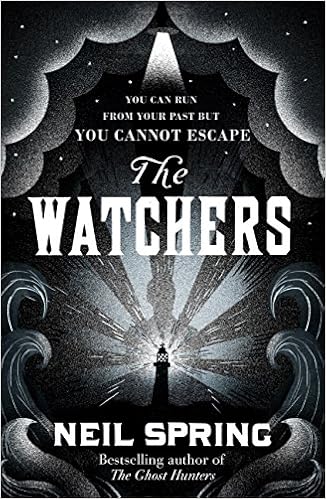
Cold war paranoia, a remote Welsh village, mysterious objects in the sky and potential military conspiracy. These were the ingredients which attracted me to The Watchers by Neil Spring as I looked around the Horror, Science Fiction and Fantasy section of Waterstone’s for the ‘genre’ book of my current reading challenge. I was also attracted by the fact that it did not appear to be part of one of the sprawling, multi-book sagas which are so common in Fantasy and Science Fiction. Not that there is anything wrong with long series, but they do not suit my current purpose of reading a wider range of different books.

The term genre is controversial; I could (and might) fill another blog post with my thoughts on the matter, but for this reading challenge, I am considering novels which are given their own section in bookshops to be ‘genre’ and everything in the general fiction section to be ‘non-genre’.

The Watchers tells the story of Robert Wilding, a parliamentary researcher who is sent on a secretive mission to investigate a series of UFO sightings in the Havens, the coastal Welsh village where he grew up. Along the way, he will re-unite with his grandfather – a religious fanatic – and uncover the details of his parents’ mysterious deaths many years before.

Spring makes good use of frame narratives to tell the story, hinting at wider ranging implications of the events on which the novel centres, and eventually setting the scene for a sequel (so much for my choice of a ‘stand-alone’ novel). Particularly interesting is Spring’s use of extracts from parliamentary reports, interviews with survivors and other in-world texts to allow us a range of perspectives and to build tension towards the novel’s climax. This is a much more successful technique than the ‘I thought it couldn’t get worse, but then it did’ style of foreshadowing which Spring somewhat overuses.

The Watchers hits all of the right beats for a thrilling super-natural mystery with a satisfying, action-movie set-piece at the end. It also incorporates a number of elements which I found to be potentially interesting. I like it when books have range of reference points and this one manages to take in noted occultist Aleister Crowley, the Egryn Lights, Ley lines and secret military experiments. The book’s title, The Watchers, refers to the angelic beings mentioned in the apocryphal books of Enoch, who are credited with the promethean act of imparting forbidden knowledge to mankind in the era before the flood. Unfortunately, this aspect of the Watchers is not really explored in the novel, and they become more generic fallen angels.

There is an irony in this, as the idea that knowledge should be shared freely rather than hidden away by those in power is introduced early in the novel: the protagonist’s mother is blinded during a protest about secret American nuclear weapons on British soil, and Robert Wilding is driven in part by his desire to find out the truth of these circumstance and to force the Americans to be more open about their actions in Britain. Wilding’s search for truth is set up in opposition to many of the other characters in the book, from the scared villagers, to the military, to his own grandfather, who are all withholding information from him. The Watchers mythos, which is sometimes associated with ancient alien conspiracy theories, would fit nicely with the story that Spring initially seems to be telling.

Perhaps one reason why Spring ignores the stories of the Watchers teaching mankind skills like writing, astrology, magic and blacksmithing, is that they are simply on the wrong side. While truth, and freedom of information appear at first to be among the books main themes, the power of Christian faith later becomes more prominent. This is an aspect of the book that worked less well for me. I do not know whether Spring is a Christian, or whether he merely found that Christian mythology allowed him the best framework for the story he wanted to tell, but I found this aspect of the book to be annoyingly preachy. One possible reading of the book would be that it tells the story of a character who has is unsuccessfully searching for truth and meaning in his life through secular institutions, but eventually finds it when he casts aside his scepticism and embraces the Christian faith which allows him to combat the power of evil. In this interpretation, it is also noteworthy that (spoiler alert) the local Catholic priest, who had allowed his doubts about Christianity to steer him towards Communist sympathies, ultimately finds that his weakened faith is not enough to protect him, and sacrifices himself in his attempts to save others. However, although I was not carried along by this aspect of the novel, I did find myself rooting for Wilding’s reconciliation with his grandfather, Randall Llewellyn Pritchard, whose apparent fanaticism is justified by the novel’s conclusion.

Despite my (non-militant) atheism, I do not, in theory, have a problem with religious art. The Exorcist (film, not book – which I haven’t read), for example is able to deal with the idea of evil in a clearly Christian context in a way which is both powerful and haunting. I do, however, think that making the ancient evil derive clearly and straightforwardly from Judeo-Christian tradition lessons its impact a little, in that it gives it makes it explainable. Once your eldritch abomination has a clearly definable origin story (complete with a kryptonite as simple as ‘believing really hard’) it ceases to be scary. I also wonder if one reason I did not get along with the novel’s Christian aspects was that I felt a little tricked into it – there were few clues set out for us to pick on, and it felt less like a plot twist, and more like a sudden realisation that I wasn’t reading the book I thought it was. This would, perhaps, have been forgivable if it weren’t for some other plot features which failed to convince. For example (Spoiler alert), the local ‘rotary club which doubles as an evil cult’ reminded me a little too much of the Simon Pegg and Nick Frost film Hot Fuzz for me to take it as seriously as The Watchers wants us to.


This is not to say that there is nothing to enjoy here. If you are looking for a straightforward supernatural thriller, and can stomach the evangelism, The Watchers provides a decent Dr Who style mystery combined with a high-stakes ending which, if it had taken place over New York, would not have seemed out of place at the climax of an Avengers movie. I enjoyed Spring’s innovative use of different texts, and he makes good use of classic Gothic tropes such as isolated villages, creepy hotels, ruined castles and pertinent warnings from seemingly crazy old men. I rarely found the novel to be genuinely unnerving – something I think is a key marker of success in a horror novel – but on a human level, Robert Wilding is a relatable and sympathetic narrator and many of the other characters are similarly well-drawn. Unfortunately, these successes did not, for me, outweigh the novel’s failures. I doubt I’ll be looking for the sequel.

Saturday, 24 December 2011

Must Try Harder

It is about eleven on Christmas Eve Eve. I am in Asda buying snacks and pop to mix with the spirits we have at home. It is filled with people buying huge quantities of crisps, breaded mozzarella fingers and Advocaat. I have just had to wait in the ‘20 items or less’ self-service queue for ten minutes while a couple scan through an entire large trolley worth of alcohol and ready meals, and another man struggles with the mysteries of the barcode scanner. My arms are loaded with heavy bags; I am glad to finally be heading towards the rotating doors which lead to freedom and cool air.

But wait! As I walk past the last row of self-scan checkouts I spot something which troubles me. A skinny young woman in pink tracksuit, mouth hanging half open, is about to finalise her purchase of Santa Baby, the latest ‘novel’ by Katie Price’s ghost-writer. Filled with the charity of the season and the snobbishness of the English graduate, I think ‘I must do something to prevent this affront to everything I stand for.’ I fight back the urge to approach the woman, pick up her book, and say “ma’am, I have as much confidence in Katie Price’s ability to write a novel as I do in your ability to read it”, then watch as she puzzles of the meaning of my words. I leave the store feeling sickeningly smug.

On my way home, through the dark streets of Wolverhampton, I am smacked by a grim realization. Katie Price has four autobiographies, seven novels, and twenty six children’s books on the market. I have one book of verse which has only sold three copies, and I bought all of those. I know that quality is more important than quantity, and I feel in my self-important heart that my book must be better than any of Jordan’s, but there is one fact that I cannot ignore.

I have written a handful of paragraphs and two or three lines of verse in the past few weeks. Even with a ghost writer in tow, Katie Price clearly spends more time working on her literary career than I do. How can I call myself a writer when I apparently put less effort into writing than Britain’s most famous blow-up doll?

And so it becomes clear. I must try harder. And step one is to reinstitute this blog, and make it better than ever before. Watch this space folks, and have a Merry Christmas.

Thursday, 6 January 2011

Book Review: Scarlett Thomas, 'Our Tragic Universe'

'Never judge a book by its cover,' says the old adage. While I know this is the case, I've often had a problem with this statement. If you aren't supposed to judge a book by it's cover, what do you judge it by? You can't just stand in Waterstones reading a whole book. Believe me, I've tried.

Luckily, anyone judging one of Scarlett Thomas's books by their beautiful hardback covers will not be disappointed by their content. I first came across Scarlett Thomas through The End of Mr. Y, which tells the story of a PhD student writing a thesis on late Victorian thought experiments, who finds a supposedly cursed book containing instructions on how to reach a psychic realm known as the 'troposphere'. If this all seems increasingly far fetched, be assured Thomas's prose is strong enough to carry the reader through it, and there are so many interesting philosophical ideas crammed within its pages that it makes for genuinely intelligent, thoughtful reading. I loved it, and started lending it to people almost as soon as I had put it down.

Last week I was pleasantly surprised when one of these people bought me a copy of her latest book, Our Tragic Universe, for my birthday. Especially as I needed something to read before the start of the next semester and a return to busy reading lists. Before opening it, judging the book by its cover, I saw that Cannongate's design department had once again excelled themselves.

The book's protagonist, Meg, lives with her boyfriend in Devon, ghostwriting teenage genre fiction to pay the bills while her 'proper' novel shrinks and changes shape but never seems to progress. There is a trend in fiction to centre stories around middle class bohemians, especially writers and publishers, and I sometimes worry that the whole thing could collapse into a smug, self referential black hole. In Our Tragic Universe, despite a cast made up almost exclusively of middle class bohemians, this does not seem to be a problem. The characters are human, likable, but imperfect. They move through the story getting together, breaking up, making unexpected fortunes, changing from happiness to sadness or from sadness to happiness, meeting fairies and searching for a monster on Dartmoor, but none of it feels climactic.

In most books this would be a flaw, but in a book which concerns itself so often with questions of plot, the nature of fiction and it's relationship to real life, it seems appropriate that despite all these reversals we finish the book feeling as if nothing much has happened. Indeed, one of the book's central questions is that of how to avoid simplistic expectations of a neat plot where the hero overcomes the monster and all loose ends are tied, both in fiction and in the ways we use its structures to understand our real lives.

Scarlett Thomas teaches creative writing in Kent, and it is clear that this has inspired some of the ways in which this book examines the structures of fiction, making it an interesting read for aspiring writers. While the book reflects the 'storyless stories' it discusses, it does it in such a way which to me, never felt boring, although I'm sure some readers would find it slow to start, I expect most of them would be won over by the end, which despite the feeling that nothing has been overcome, still gives a satisfying sense of conclusion.

Thursday, 15 July 2010

Official Launch

Ladies and Gentlemen,

I am glad to announce the official launch of the new BCU literary magazine, Paper Tiger. Thanks to everyone who submitted or was involved at the planning stages.

Read it, hot off the virtual presses at www.apapertiger.tk

Email any submissions for future issues to apapertiger@live.co.uk

Sunday, 18 April 2010

Quick Notice (let's make this happen)

Tomorrow, at 1pm, there is an open meeting about an English Department Literary Magazine in B609. If you are an English student at BCU you may have gotten a text about it. I fully intend to be there, and suggest anyone with an intrest does the same.

Towards the end of last academic year myself and another student, Alex Kent, attempted to get a literary magazine started. Due to a large dose of naivity, this dwindled to a couple of pages in the student union magazine, Spaghetti Junction. We never thought of suggesting it to the department and our knowledge of publising things like this was minimal. We received no submissions, and the page quickly starved to death.

I only hope that with the department backing us, and a fuller pannel of people working on it, this time will be different. We have a great Creative Writing course at BCU and the people on it deserve a place to showcase their work. Come on everbody, lets make this happen.

Sunday, 21 March 2010

Review: 'Confessions of an English Opium Eater'

Some of you may be wondering why I chose to call this blog 'Undertheinfluence'. Well, my intention was to emphasis the fact that as aspiring (or, to put it in a way which sounds less up-my-own-arse, 'wannabe') writer, I will always be unavoidably influenced in one way or another by whatever I happen to be reading at the time (and everything else I've ever read). In that spirit I've decided that it would be a good idea to stick the occasional book review up here. 'Occasionally' meaning whenever I finish reading a book, which is nowhere near as often as it should be. I'll also do a poetry review every month, in keeping with my earlier pledge to read a collection every month.

The first book I'll be reviewing is Thomas de Quincey's Confessions of an English Opium Eater, which seems appropriate given the name of the blog. I had to read this for my 'Romantic Century (B)' module at uni, but (if you're reading Ian) it could also sit nicely on the 'Life Writing' reading list. At eighty-eight pages it is more properly a journalistic essay than a book, and was initially published in two parts in the London Review in 1821. Despite it's short length though the book is full of interesting episodes which give a rich picture of life in early 19th century Britain. For example, we are told that Manchester factory workers would often spend their wages on opium because 'the lowness of the wages... would not allow them to indulge in ale or spirits'. Times have clearly changed. I've never tried to buy heroin, but I imagine it would cost me a fair bit more than a pint.

De Quincey's descriptions of being essentially homeless in London and Wales are intriguingly juxtaposed with episodes where he is mixing with young aristocrats at Eton, and the hallucinogenic Opium-dream sequences build layer upon layer of hypnotic detail. What is really interesting about this work though is de Quincey's style of writing which is capable of both wit and seriousness. For a confessional autobiography he doesn't actually give the reader much detail about his life in the period when he was taking opium, partly because of his decision to remain anonymous. This lack of background information does not seem to matter though as de Quincey guides the reader through a whirlwind off different associations, often addressing them directly.

I once saw a review of Trainspotting which described it as 'the voice of punk grown elequent', but this heroin story gives us a voice which is truly elegant.

Tuesday, 16 February 2010

A Confession...

Hello, my name is Luke, and I have an addiction. I’m not an alcoholic (although they do say admitting it is the hardest part). I’m not, to the best of my knowledge, addicted to sex or drugs, and while I will confess to a minor addiction to Rock and Roll, that’s not what I’m here to talk about. My addiction began probably before I turned two, and as of yet shows no sign of abating. Ladies and gentlemen, I am addicted to words. My rate of consumption is difficult to determine, due to the pressures of university life I currently get through a novel almost every week, in addition to plays, poems, magazine articles, films, television programmes, adverts, song lyrics and countless conversations. What’s worse is that I’ve now started dealing. I suppose everyone deals here and there, but I’d very much like to make a living out of it (yes, this is going to be one of those ‘struggling/aspiring/wannabe writer’ blogs, apologies to those of you who were hoping for something a little more ‘trainspotting’).

Where does this addiction come from? I don’t know. What I do know is that I just love words. All sorts of words. Words which crack and slap and spit. Words which you sound like other words. Words which you can pick apart one syllable at a time. Words which you can roll around your mouth as you say them (of which ‘bollock’ is an unfortunately literal-sounding example). Words which mean more than one thing. And I love what happens when you string words together to make a story or a poem. The way they can be made to pierce the heart or tickle the funny bone. They say a picture is worth a thousand words, but I think that sometimes ten well chosen words can say more than a thousand pictures (no offence to any visual artists out there). Anyway, that’s what this blog is about. Not necessarily individual words themselves, but my attempts to become a better (and with any luck, better known) writer, and about anything which pops into my head to write about. Hopefully I’ll be able to make it interesting, and not as pretentious as it has the potential to be (feel free to let me know if it’s heading in that direction). Here’s to a better blog next time, not because I think this one is bad, but because improvement is the way forward.